


Table of Contents
- Smart Lighting vs Traditional Bulbs: Initial Purchase Cost Comparison
- Understanding Smart Bulb Energy Consumption and Efficiency
- Smart Bulb Standby Power Usage: The Hidden Drain
- Smart Home Lighting ROI: When Do You Break Even?
- Lifespan and Durability: LED vs Smart Bulbs
- Total Cost of Ownership: Infrastructure, Setup, and Maintenance
- Smart Features and Convenience Benefits Worth the Premium
- Conclusion
- Frequently Asked Questions
Last Updated: September 21, 2026
Smart Lighting vs Traditional Bulbs: Initial Purchase Cost Comparison
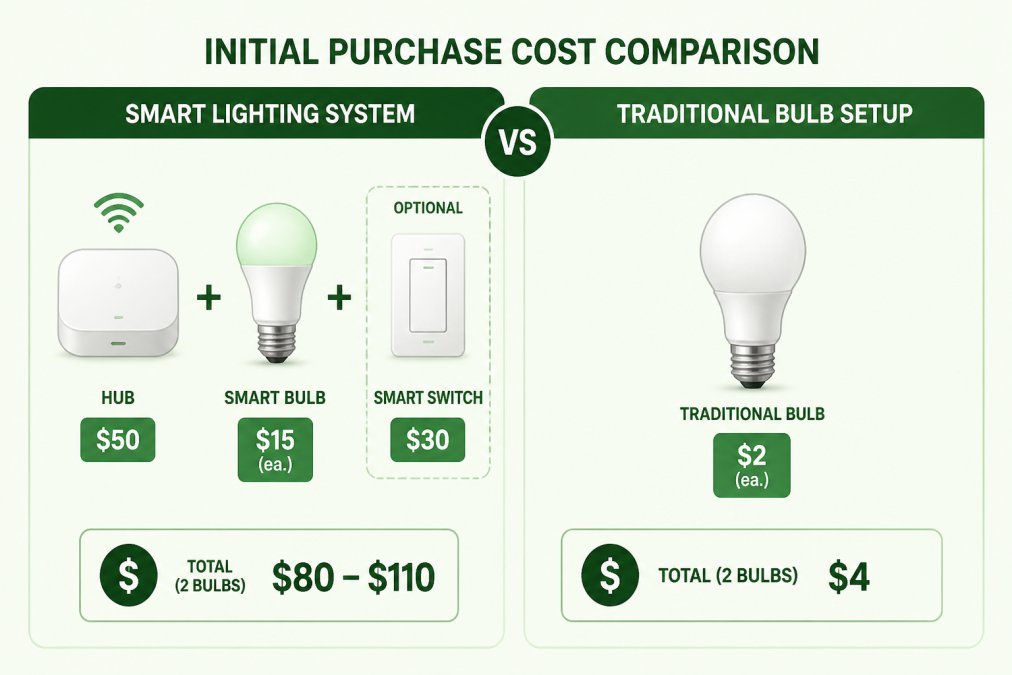
When you're standing in the lighting aisle considering smart lighting vs traditional bulbs cost, the price difference hits immediately. A traditional incandescent bulb costs a few dollars. A smart bulb? Often $15-30 per unit. That's a significant gap for a single fixture, and it compounds fast if you're outfitting an entire home.
Initial bulb price tells only half the story.
The True Entry Cost: Bulbs Plus Infrastructure
Traditional incandescent and LED bulbs have minimal infrastructure requirements. You buy the bulbs, screw them in, and you're done. No hub. No bridge. No smart switch. The total upfront cost is purely the bulb price multiplied by fixture count.
Ecosystem Lock-In and Compatibility Costs
Smart lighting ecosystems are not interchangeable. Bulbs designed for one platform often cannot communicate with hubs from another. Switching ecosystems may require purchasing a new hub and replacing bulbs, an additional cost traditional lighting never imposes.
When Infrastructure Cost Becomes Negligible
Infrastructure cost matters most for small projects. A 20-bulb system spreads hub cost to $15 per bulb; a 5-bulb system pays $60 per bulb.
The Hybrid Approach: Reducing Infrastructure Cost
Start with motion-sensor or battery-powered bulbs that don't require a hub, then expand later if benefits justify the investment.
Understanding Smart Bulb Energy Consumption and Efficiency
Smart bulbs and LEDs consume far less power than incandescent bulbs. The difference lies in standby consumption and operational efficiency.
Incandescent bulbs consume roughly 60 watts per bulb; LED and smart bulbs deliver the same brightness at 8-12 watts. Smart bulbs add a small continuous draw for wireless connectivity.
This efficiency gap compounds annually. A 20-fixture home using incandescent bulbs consumes significantly more kilowatt-hours than one using LEDs or smart alternatives.
Smart Bulb Standby Power Usage: The Hidden Drain
Standby draw is small per bulb (0.5-2 watts) but cumulative across 10-20 bulbs. Understanding this drain is essential to calculating realistic energy savings.
Quantifying Standby Consumption
For a 15-bulb home: 15 watts × 16 standby hours daily = 0.24 kWh daily, or 87.6 kWh annually. At $0.14/kWh, that's roughly $12-15 per year. A 30-bulb installation doubles this cost to $24-30 annually.
Standby Drain vs. Active-Use Efficiency Gains
Incandescent baseline (15 bulbs × 60 watts × 8 hours daily): 2,628 kWh annually, costing $368 at $0.14/kWh. Smart LED scenario (15 bulbs × 10 watts active + 15 watts standby): 526 kWh annually, costing $74. Net savings: $294 even accounting for standby drain. Standby consumption reduces efficiency gains by 3-5% but remains small relative to overall savings.
When Standby Drain Becomes More Significant
Standby consumption matters more in: very large installations (40+ bulbs, $40-50 annually); high-rate regions ($0.18-0.20+/kWh); low-usage patterns (lights on 2-3 hours daily); and Wi-Fi bulbs (1.5-2 watts standby vs. 0.5-1 watt for hub-based).
Motion Sensor Cabinet Light with →
Reducing Standby Drain
Minimize standby drain by: choosing hub-based systems over Wi-Fi; using motion-sensor or battery-powered bulbs in low-use areas; limiting smart bulbs to high-use fixtures (4+ hours daily); and selecting bulbs with published low standby specs.
Smart Home Lighting ROI: When Do You Break Even?
Beyond pure energy savings, smart lighting delivers ROI through convenience and automation benefits. Scheduling lights to turn on at sunset, automating security lighting when you're away, and controlling lights remotely reduce wasted energy from forgotten-on fixtures. These behavioral savings often exceed the raw kilowatt-hour reductions.
Lifespan and Durability: LED vs Smart Bulbs
However, smart bulb durability depends on maintaining a stable wireless connection and avoiding power surges. Bulbs that lose connectivity may become unusable even if the LED element still functions. This is a practical consideration that affects real-world lifespan, even if the rated lifespan remains high.
Total Cost of Ownership: Infrastructure, Setup, and Maintenance
Total cost of ownership captures everything: bulbs, hubs, installation, maintenance, and operational costs across the life of your lighting system.
| Cost Factor | Traditional Bulbs | Smart Bulbs |
|---|---|---|
| Initial bulb cost per fixture | $2-5 | $15-30 |
| Hub/infrastructure | None | $30-50 |
| Annual replacements (20 fixtures) | 15-20 bulbs | 0-2 bulbs |
| Annual energy cost (20 fixtures) | $80-120 | $15-25 |
| 5-year total cost | $550-700 | $400-500 |
| 10-year total cost | $1,100-1,500 | $600-800 |
MixVanta offers practical smart lighting options like the Wireless Motion Sensor Light at $14.07, which reduces infrastructure costs compared to full smart home systems. Motion-activated lighting provides energy efficiency and convenience without requiring a central hub, making it a lower-cost entry point for smart lighting benefits.

Smart Features and Convenience Benefits Worth the Premium
The premium for smart features is real and significant. You're paying for connectivity, app infrastructure, and automation logic. For users who value these features heavily, the cost is justified. For those focused purely on cost minimization, traditional LEDs deliver efficiency at lower price points.
Conclusion
Smart lighting versus traditional bulbs isn't purely a cost question, it's a cost-versus-benefit calculation. Traditional incandescent bulbs are cheapest upfront but most expensive over time. Standard LED bulbs offer excellent energy efficiency at moderate cost. Smart bulbs demand higher initial investment but deliver convenience, automation, and long-term cost savings.
MixVanta's smart lighting solutions like the Motion Sensor Cabinet Light with Battery Display at $36.99 provide practical entry points into smart lighting without requiring expensive hub infrastructure. These motion-activated options deliver energy efficiency and hands-free convenience, the core benefits of smart lighting, at competitive pricing. Explore MixVanta's full range of smart and traditional lighting options to find the right solution for your home and budget.

Frequently Asked Questions
Do smart light bulbs raise the electric bill?
Smart bulbs themselves consume less electricity than incandescent bulbs when on, but they can increase standby power draw if connected to Wi-Fi or zigbee networks. When you account for standby power usage and hub operation, the savings shrink compared to basic LED bulbs. However, smart lighting ROI improves when you use automation to reduce overall usage, scheduling lights off during the day or using motion sensors cuts consumption significantly. Most households see savings within 1-2 years despite higher upfront costs.
What is the average cost of smart light bulbs compared to LEDs?
Motion sensor lights like the [Wireless Motion Sensor Light](https://mixvanta.store/products/wireless-motion-sensor-light) at $14.07 offer smart features at a lower entry point than full smart home systems.
How much electricity do smart bulbs use when turned off?
Smart bulb standby power usage ranges from 0.3-0.5 watts per bulb when off, depending on whether they're connected to Wi-Fi or zigbee networks. A hub can draw 2-5 watts continuously. For 10 smart bulbs plus a hub running 24/7, that's roughly 5-8 watts baseline. Over a year, this adds $6-$10 to your electricity bill. Traditional LED bulbs draw almost nothing when off, making them more efficient if you rarely use smart features like remote control or scheduling.
Do smart bulbs save money over their lifespan?
Smart bulbs last 15,000-25,000 hours (about 15 years at 3 hours daily), compared to 10,000 hours for standard LEDs. Assuming $0.12 per kilowatt-hour, a smart bulb running 3 hours daily costs $7-$10 annually in electricity, while an LED costs $5-$8. The $10-$20 price premium per bulb breaks even in 2-3 years through energy savings. Smart home lighting ROI accelerates when you add automation, motion sensors, schedules, and dimming can cut usage by 30-50%, recouping costs faster.
What are the hidden costs of smart lighting systems?
Motion sensor lights like the [Motion Sensor Cabinet Light](https://mixvanta.store/products/smartglow-motion-sensor-cabinet-light-with-battery-display) at $36.99 eliminate hub costs for single-room applications, reducing total system investment.


