


Last Updated: November 3, 2026
Quick Summary
Choose interactive toys by matching them to each pet's hunting sequence: dogs want the chase to end in a grab or treat, while cats want unpredictable pursuit. Stock motion-activated balls for dogs and teaser or puzzle toys for cats, then rotate three to five toys per pet to keep them novel.
- Motion-activated balls are the lowest-effort entry point into interactive play for dogs and cats.
- Ten minutes of problem-solving often settles a dog better than a longer game of fetch.
- Start puzzle feeders with food visible and easy to reach, then make each session harder.
- In multi-pet homes, keep one toy per pet plus one spare to prevent resource guarding.
- Puppies and kittens need soft toys and short 5-10 minute sessions with constant supervision.
Table of Contents
- Why Interactive Toys Work for Both Dogs and Cats
- Motion-Activated Balls: The Easiest Interactive Toys to Start With
- Dog Mental Stimulation Toys That Tire Out a Busy Dog
- Interactive Puzzle Feeders for Dogs and Cats
- Plush and Sound Toys for Gentle, Indoor Play
- Safe Toys for Multi-Pet Households
- Matching Toys to Age, Size, and Energy Level
- Building a Rotation That Keeps Both Pets Busy
- Frequently Asked Questions
Why Interactive Toys Work for Both Dogs and Cats
Interactive toys are objects that respond to an animal's actions with movement, sound, or a food reward, turning solo play into a problem to solve. This guide from MixVanta covers how to pick them for dogs and cats, because the same hunting sequence drives both species. A stalking cat and a chasing dog are running the same program: track, pursue, pounce, and sometimes eat the prize.
The difference sits in the finish. Dogs usually want the chase to end in a grab or a treat. Cats want the pursuit itself, and they lose interest the moment the outcome becomes predictable.
That single distinction explains most bad purchases. A toy that rolls in a straight line bores a cat within minutes. A toy that a dog can pin down in one pounce stops being a challenge. The American Society for the Prevention of Cruelty to Animals notes that play is a core part of keeping pets mentally and physically healthy, which is why the wrong toy costs more than money. It costs the routine.
Below, we break down each toy type by species, then show how to match toys to age, size, and energy level, and how to build a rotation that keeps both pets busy.
Motion-Activated Balls: The Easiest Interactive Toys to Start With
Motion-activated balls are the lowest-effort entry point into interactive play: you switch them on and the toy does the work. They roll, change direction, and trigger a chase without a human holding a wand.
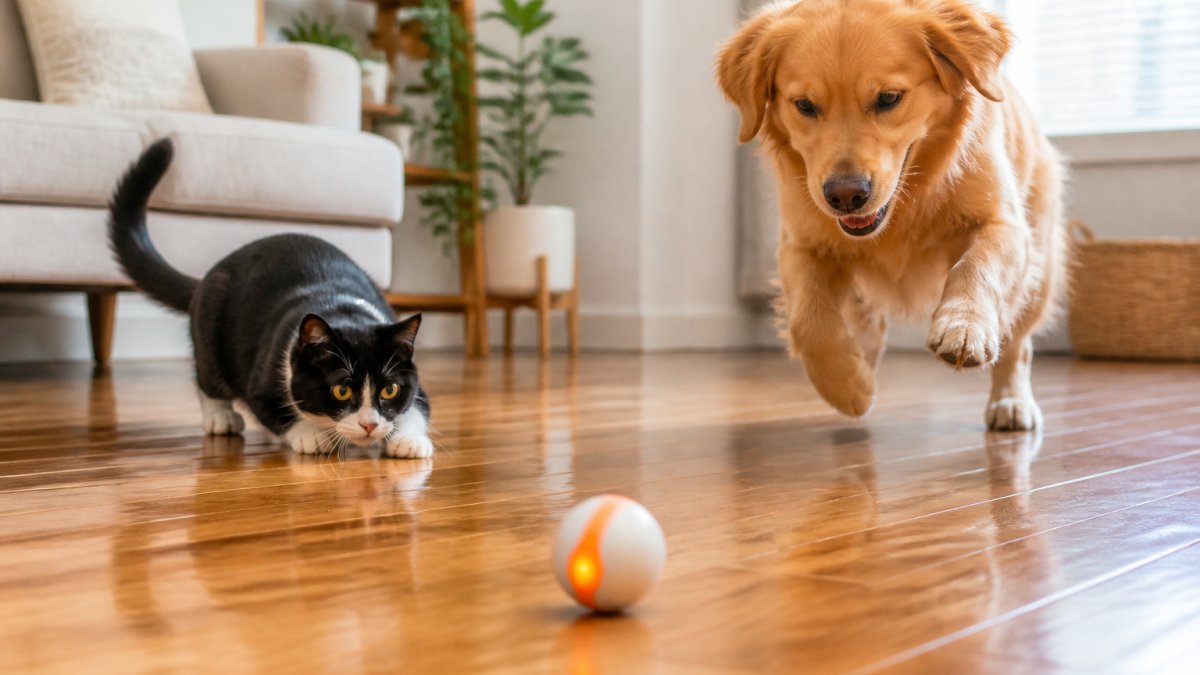
For dogs, the Interactive Dog Toy Ball suits puppies and adult dogs of all sizes and works indoors or outdoors, which matters if your play space changes with the weather. The Pet Dog Rubber Ball Toys For Dogs adds two modes, Smart and Normal, plus a chew-resistant rubber build.

Cat owners get a wider field. The Smart Interactive Cat Teaser Ball rolls automatically to mimic prey movement and recharges by USB-C. The Interactive Indoor Cat Ball Toy adds 360-degree obstacle avoidance and two speed modes.


Watch out: hard flooring amplifies the noise, and a ball that runs under a sofa for good will frustrate a cat fast. Clear a small open zone before the first session.
Dog Mental Stimulation Toys That Tire Out a Busy Dog
Dog mental stimulation toys work by making a dog think for a reward, and they tire a dog out faster than a sprint around the yard. Ten minutes of problem-solving often settles a dog more effectively than a longer, mindless game of fetch.
The Dog Treat Launcher combines movement with food: it dispenses treats as your dog chases, which turns a simple game into reward-based training. It is light enough to carry to a park or backyard.
For a dog that eats too fast or needs a longer challenge, the puzzle feeder approach covered in the next section does more work per session.
A common mistake is loading a new puzzle to the brim. Start with the dispensing opening wide and the toy nearly empty of challenge.
Interactive Puzzle Feeders for Dogs and Cats
Interactive puzzle feeders are containers that release food as an animal works at them, combining mealtime with problem-solving. They suit both species because both are natural foragers.
The Dog Treat Dispenser releases treats or kibble as a dog plays, and its dispensing opening can be adjusted.
| Toy type | Best for | Effort to start | Supervision needed |
|---|---|---|---|
| Motion-activated ball | Bored dogs, indoor cats | Low | Light |
| Treat launcher | Training and bonding | Low | Moderate |
| Puzzle feeder | Fast eaters, long sessions | Moderate | Moderate |
| Plush and sound toy | Gentle play, comfort | Low | Light |
Cats take to puzzle feeders with a little coaching. Start with the food visible and easy to reach, then make each session slightly harder. A cat that has never foraged may ignore the feeder for a day, then commit fully once the smell registers.
Plush and Sound Toys for Gentle, Indoor Play
Plush and sound toys cover the softer end of the range: comfort objects, squeakers, and motion toys for pets that find a rolling ball too much. They are the right pick for older animals, shy cats, and any pet that needs a calm outlet.
The Calming Duck Toy is a soft plush companion with a built-in squeaker, suitable for dogs and cats. The Pet Plush Toy goes further: it jumps, flaps, and makes sound to mimic prey, runs on a USB-rechargeable battery, and suits cats and small dogs.
Here is the honest limitation. Plush toys may not hold up to a determined chewer. If your dog destroys stuffed toys in minutes, buy plush for supervised comfort only and keep the durable rubber and puzzle toys for solo time.
Safe Toys for Multi-Pet Households
Safe toys for multi-pet households are the ones that survive shared play without creating a resource to fight over. The rule we recommend is simple: one toy per pet, plus one spare, and no toy that only one animal can control.
That rules out a single automatic ball in a two-pet home. Buy two, or rotate one toy at a time so nobody guards it.
Smart Interactive Cat Teaser Ball →
Size matters as much as quantity. A ball small enough for a cat to bat is small enough for a large dog to swallow.
Material durability is the second filter. Rubber and hard plastic toys survive shared play; plush and fabric toys do not.
Supervision is not optional for the first few sessions. Watch how each pet reacts, separate them if one guards, and intervene before a toy becomes a prize to defend.
Species-specific play also matters. Cats want pursuit and unpredictability; dogs want the chase to end in a grab or treat. A toy that satisfies both is rare.
Finally, establish a cleanup routine. After play, remove small parts, charge electronic toys out of reach, and store everything in a bin the pets cannot access. This prevents unsupervised chewing and keeps the rotation system intact.
Matching Toys to Age, Size, and Energy Level
Matching a toy to the pet in front of you beats buying whatever is trending. Puppies and kittens need soft, forgiving toys and short sessions. Adult working breeds need a challenge that scales up.
Puppies and kittens (under 6 months): Soft plush, gentle rolling toys, and wide-opening puzzle feeders. Sessions should run 5-10 minutes, several times a day, with constant supervision. Puppies explore with their mouths, so avoid small parts, squeakers that can be pulled out, and any toy that fits entirely inside the mouth. Kittens need toys they can bat and chase, lightweight balls, wand teasers, and small motion toys, but they tire quickly and lose interest if the toy is too difficult.
High-energy adults (1-7 years): Motion-activated balls, treat launchers, and puzzle feeders with tight openings. These pets need a challenge that scales up: a puzzle feeder that releases food too easily becomes boring within a week. Look for adjustable difficulty, a dispensing opening you can narrow, or a ball with multiple speed modes. Ten minutes of problem-solving often settles a high-energy dog more effectively than a longer, mindless game of fetch.
Low-energy or senior pets (7+ years): Plush toys, wide-opening feeders, and floor-level play. Senior pets may have reduced mobility, vision, or hearing, so choose toys that do not require jumping, fast turns, or high-pitched sounds.
Pets with limited mobility or disability: Look for toys that can be played with from a lying or sitting position. Treat-dispensing toys that roll slowly, snuffle mats, and puzzle feeders with large, easy-to-reach compartments work well.
Size and dimensions: A toy should be large enough that your pet cannot swallow it, but small enough to carry or bat comfortably. For dogs, a common guideline is that the toy should be larger than the dog's mouth when fully open.
Energy level and play style: Watch what your pet does with a cardboard box before you spend anything. A calm retriever may ignore a rolling ball entirely, while a small terrier may chase one for an hour.
A common mistake is buying for the pet's breed instead of its actual behavior. Breed gives you a starting point, but individual personality, age, and physical ability determine whether a toy will be engaging or frustrating.
Building a Rotation That Keeps Both Pets Busy
A rotation is the system that keeps interactive toys interesting: you cycle toys in and out so each one feels new when it returns. Three to five toys per pet is enough. More than that and nothing feels special.
The routine that works:
- Pick three toys per pet and store two out of sight
- Swap the hidden toys in every few days
- Charge every electronic toy on the same day each week
- Check each toy for damage before it goes back into rotation
- Retire any toy your pet has stopped engaging with
For more indoor ideas to fill the gaps between rotations, see our guide on how to keep your dog entertained indoors.
A pet with a rotation has something to do when the house is empty. MixVanta stocks a range of interactive toys in one place, with free shipping on orders over $70 and a 30-day money-back guarantee.
Frequently Asked Questions
What are some toys that dogs and cats can play with together?
Motion-activated balls are the safest shared option because they move on their own and don't require one pet to grab the toy from the other. The Interactive Dog Toy Ball at $16.99 and the Self-Playing Rolling Cat Ball at $16.99 both work for mixed households, though you should supervise the first few sessions. Plush toys with squeakers, like the Calming Duck Toy at $21.99, also suit both species.
What is the most interactive dog toy for mental stimulation?
A treat-dispensing puzzle gives a dog the most mental work per session. The Dog Treat Dispenser at $44.99 releases kibble as the dog plays and has an adjustable opening, so you can make it harder as the dog figures it out. For a cheaper entry point, the Dog Treat Launcher at $14.99 adds a chase element to reward-based play. Rotate between the two so the puzzle stays novel.
Are there specific toys safe for both dogs and cats?
Look for toys with no small removable parts and no long strings. The Smart Interactive Cat Teaser Ball at $16.99 uses ABS and silicone with no loose pieces, and the Pet Dog Rubber Ball Toys at $36.99 has a removable TPR shell you can rinse, which keeps it hygienic in a shared home. Always supervise plush toys, since a dog can pull stuffing out of a toy that was fine for a cat.
How often should I rotate my pet's interactive toys?
Swap toys every three to five days and keep two or three out at a time. A toy that stays on the floor for weeks stops triggering interest, especially with automatic balls that a pet has already figured out. Store the rest out of reach, recharge the electronic ones, and bring them back as if they were new. This rotation habit costs nothing and stretches the value of every toy you buy.
The hardest part of interactive play is not finding a toy. It is building the habit of swapping, charging, and checking them before boredom wins. MixVanta makes that easier with a catalog that covers every category in this guide, free shipping on orders over $70, fast handling, and a 30-day money-back guarantee if a toy does not fit your pet. Get started with MixVanta and give both your dog and your cat a rotation worth waiting for.


