


Last Updated: October 29, 2026
Quick Summary
Portable space heaters are worth it for a small home office when you match wattage to the room instead of buying the biggest unit. A 400 to 800-watt heater with a real thermostat handles a compact office quietly and cheaply, while oversized 1,500-watt models short-cycle and waste power.
- A 400 to 800-watt unit handles a tight office without tripping breakers or cooking the room.
- A heater that heats 300 square feet will short-cycle in a 100-square-foot office and wear out faster.
- Keep at least three feet of clearance on all sides, especially from curtains and paper.
- Plug heaters directly into a wall outlet, never into extension cords or power strips.
- A 750-watt heater running 6 hours at a 40% duty cycle uses about 1.8 kWh per day.
Table of Contents
- Why a Small Home Office Changes the Space Heater Math
- What Makes the Best Space Heater for Small Room Setups
- Picking a Quiet Space Heater for Office Calls and Focus Work
- Is It a Safe Space Heater for Home Office Use?
- Space Heater Electricity Usage: What It Actually Costs to Run
- Mistakes That Make a Portable Heater a Bad Buy
- Choosing Your Heater and Setting Up Your Desk
- Frequently Asked Questions
Why a Small Home Office Changes the Space Heater Math
A small home office is a different heating problem than a living room. The Department of Energy's guidance on space heater safety is blunt about the core issue: electric space heaters are built for spot heating, not whole-room climate control.
Room size matters a great deal. A compact office holds far less air than an open floor plan, so a heater rated for a large room will cycle on and off constantly, overshoot the set temperature, and waste power.
Square Footage, Wattage, and the 1,500-Watt Ceiling
For a small office, you rarely need the full 1,500. A 400 to 800-watt unit handles a tight space without tripping breakers or cooking the room. Check the circuit your desk sits on before you buy. If the same outlet runs a printer, monitor bank, and charging station, a 1,500-watt heater will push it hard.
What Makes the Best Space Heater for Small Room Setups
The best space heater for a small room is one sized to the square footage, quiet enough for calls, and built with safety features you can verify. Three specs decide most purchases:
- Wattage match. Confirm the heater's rated output fits the room, not the whole house.
- Thermostat control. Adjustable heat settings let the unit hold a temperature instead of blasting on high.
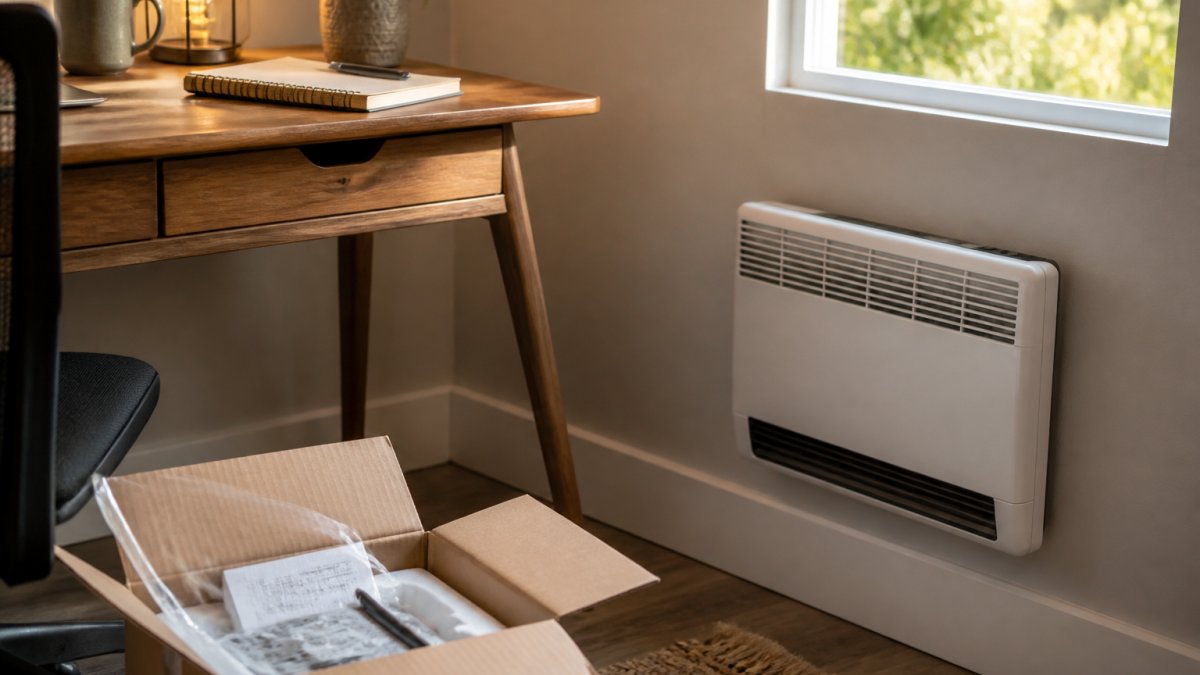
- Footprint. A wall-mounted or compact floor unit keeps desk space clear.
Small offices punish oversized heaters. A unit that heats a 300-square-foot room will short-cycle in a 100-square-foot office, and short cycling wears components faster. Buy for the room you have.
Picking a Quiet Space Heater for Office Calls and Focus Work
A quiet space heater for office use should stay under the noise floor of a normal conversation, and that rules out most fan-forced models on high.
What most guides miss is that noise isn't the only distraction. A heater that clicks loudly as its thermostat engages will break concentration just as reliably as a fan.
Our rule of thumb: if you can hear the heater over a soft-spoken video call, it's too loud for a shared workspace.
Is It a Safe Space Heater for Home Office Use?
A safe space heater for home office use is one with a tip-over switch, overheat protection, and clearance from anything flammable. The Consumer Product Safety Commission's space heater safety guidance consistently points to combustibles kept too close as a leading cause of home heating fires.
How the Safety Mechanisms Actually Work
Knowing what each safety feature does helps you check it.
- Tip-over switch. A tilt sensor cuts power when the unit is knocked over. Test it carefully while the heater runs, and if it keeps running after tipping, return it.
- Overheat protection. A thermal cutoff breaks the circuit when internal temperature gets too high. Some units reset after cooling and others need a manual reset, so check which type you have.
- Cool-touch housing. Ceramic and oil-filled units often keep exterior surfaces cooler than exposed-element coil heaters. If you have pets or kids in the office, this matters more than wattage.
- Tip-over plus timer. A built-in shutoff timer (often 8 or 12 hours) prevents the classic mistake of leaving a heater on after you leave the room.
Placement Rules That Prevent Most Accidents
- Keep at least three feet of clearance on all sides, especially from curtains, paper, and bedding.
- Set the heater on a hard, level surface. Never on carpet pile, a desk edge, or a chair.
- Plug directly into a wall outlet. Extension cords and power strips are not built for a heater's draw.
- Never leave it running unattended or overnight.
- Keep it out of the path of foot traffic and away from doorways where a cord can become a trip hazard.
Matching Heater Type to Your Office Materials
A small office is usually packed with paper, fabric, and plastic, which changes the risk profile compared with an open living room.
- Radiant (infrared) heaters warm objects and people directly rather than the air. They can feel effective in a drafty office, but the exposed element runs hot, so keep them well away from paper stacks and curtains.
- Ceramic fan heaters spread warmth faster but blow dust and paper around; keep loose documents weighted down.
- Oil-filled radiators surface-heat slowly and stay warm after shutoff, so give them extra clearance and never drape anything over them to dry.
- Wall-mounted units free floor space and reduce tip-over risk, but the mounting location must still respect clearance from shelves and window treatments.
If you're unsure how to judge build quality before buying, our guide on how to spot quality electronics online covers what to check in a listing.
Space Heater Electricity Usage: What It Actually Costs to Run
Space heater electricity usage comes down to wattage and hours. A 1,500-watt heater draws 1.5 kilowatt-hours per hour at full power; a 750-watt unit draws half that. Your bill depends on your local rate per kilowatt-hour, which varies widely by utility and season, so check your own statement rather than trusting a national average.
VersaHeat Portable Wall-Mounted Space Heater →
A Worked Example You Can Copy
Most guides stop at the formula. Here is how to turn it into a number for your own office.
- Find your rate. Look for the "price to compare" or supply rate on your electric bill, expressed in cents per kilowatt-hour (kWh). It is usually a two- or three-digit number.
- Estimate run hours. A thermostat-controlled heater does not run at full draw the whole time. In a small, well-sealed office it may cycle on roughly a third to half of the hours you are at your desk. Use your own observation rather than a guess.
- Multiply. Watts ÷ 1,000 × hours × rate = cost.
For example, a 750-watt heater running 6 hours a day at a 40% duty cycle uses about 1.8 kWh per day. At a rate of 15 cents per kWh, that is roughly 27 cents a day. The same office with a 1,500-watt heater on high for the same hours would use about 3.6 kWh, or roughly 54 cents. The point is not the exact figure, it is that halving the wattage and letting a thermostat cycle the unit roughly halves the cost.
Why Thermostat Control Beats Raw Wattage
A heater with a real thermostat holds a set temperature by cycling on and off. A heater with only high/low/off runs continuously until you switch it, which means it keeps drawing full power after the room is comfortable. For a desk-sized office, a modest unit on a thermostat is almost always the cheaper operating choice, even if its rated wattage is close to a bigger unit's.
The Hidden Costs Most Guides Skip
- Standby draw. Many heaters with digital displays or remote controls draw a small amount of power even when not heating. It is usually minor, but unplugging when not in use eliminates it.
- Oversized units short-cycle. A 1,500-watt heater in a 90-square-foot office may cycle on and off rapidly, which wastes energy at startup and wears the thermostat.
- Circuit load. Running a heater alongside a printer, monitor bank, and charging station on one 15-amp circuit can trip the breaker. A dedicated outlet avoids nuisance trips and lets the heater run as designed.
If you want to cut the rest of your small-space power draw too, our roundup of energy-saving gadgets for small apartments pairs well with heater planning.
Mistakes That Make a Portable Heater a Bad Buy
Portable heaters go wrong in predictable ways. The most expensive mistake is buying for peak cold instead of typical cold, ending up with a 1,500-watt blast furnace for a room that needed a gentle 600 watts.
- Ignoring the circuit. A heater that trips your breaker every morning is a bad buy no matter the price.
- Skipping the thermostat. On/off-only heaters overshoot and waste power.
- Chasing the lowest price with no safety listing. Look for a recognizable testing certification on the label.
- Buying oversized for the room. Bigger is not warmer; it's just noisier and costlier to run.
Watch out for listings that show a heater without a clear wattage rating or safety certification. Our breakdown of common red flags in electronics listings shows what to look for before you check out.
Choosing Your Heater and Setting Up Your Desk
Set up the heater before the cold snap, not during it. Place it to one side of your desk, not directly behind your chair, so warm air reaches you without blowing on your neck.
If you want a concrete option that fits a compact workspace, the VersaHeat Portable Wall-Mounted Space Heater mounts to the wall to keep floor space free, offers adjustable heat settings, and can be moved from room to room. Our guide to must-have gadgets for organized home offices helps you decide what else earns a spot on the desk.

Our platform carries electronics and household essentials in one place, with free shipping on orders over $70 and a 30-day money-back guarantee.
Frequently Asked Questions
What type of space heater is best for a small home office?
Ceramic fan heaters and oil-filled radiator heaters suit most small offices. Ceramic models heat a room quickly and stay compact, while oil-filled radiators run silently and hold warmth after shutoff. For a desk you sit at all day, a ceramic unit with a thermostat and tip-over shutoff covers most needs. Match the heater to your room size and accept that any standard 120-volt portable unit caps out at 1,500 watts, which is enough for one room, not a whole floor.
How many watts does a space heater need for a small office?
A typical small office of 100 to 150 square feet usually warms well with a 750 to 1,500-watt heater. Most portable heaters sold for home use max out at around 1,500 watts. Running a 1,500-watt heater on the same circuit as a printer, monitor, and laptop can trip the breaker, so check what else shares that outlet before you buy the largest model.
How much does it cost to run a space heater in a home office?
Cost depends on your electricity rate and how long the heater runs. A 1,500-watt heater uses 1.5 kilowatt-hours per hour at full power. A thermostat that cycles the heater on and off cuts real usage below the full-power figure, and your utility bill shows your actual rate per kilowatt-hour.
Can you leave a space heater on while working or away from the desk?
Leave it on while you are in the room, and turn it off when you leave. Keep space heaters away from flammable materials and never leave them running unattended or while sleeping. Choose a model with automatic tip-over shutoff and overheat protection, plug it directly into a wall outlet rather than an extension cord or power strip, and keep it at least three feet from curtains, paper, and furniture.
A cold office kills focus faster than almost anything else, and the wrong heater makes it worse. MixVanta makes the setup simple with a curated electronics catalog, free shipping over $70, and a 30-day money-back guarantee. Get started with MixVanta and build a workspace that stays warm, quiet, and safe all season.


