


Table of Contents
- Why Scheduling Home Deliveries Matters
- Setting Scheduled Delivery Time Windows
- Planning Routes and Geographic Efficiency
- How to Reduce Missed Deliveries
- Managing the Delivery Rescheduling Process
- Choosing Delivery Scheduling Software
- Communicating Schedules and Changes to Customers
- Frequently Asked Questions
Last Updated: October 12, 2026
Why Scheduling Home Deliveries Matters
Scheduling home deliveries is the foundation of reliable customer service. When you get it right, customers receive their orders on time. When you don't, missed deliveries damage trust and increase costs.
The stakes are real. A failed delivery attempt means a second trip. That doubles your fuel costs and ties up your driver's time. The customer gets frustrated. They may cancel future orders or leave negative reviews. Over time, these small failures compound into lost revenue.
At MixVanta, we understand that home delivery scheduling isn't just logistics, it's a customer experience issue. Every scheduled delivery window you set should reflect your actual operational capacity. Every communication should be clear and timely.
Setting Scheduled Delivery Time Windows
A scheduled delivery time window is the specific hours when a customer can expect their package to arrive. The window should be narrow enough to be useful but realistic enough to hit consistently.
Most teams offer 2-4 hour windows. A 2-hour window (e.g., 1 PM to 3 PM) gives customers certainty. A 4-hour window is easier to meet operationally but less convenient for the customer. The trade-off depends on your delivery volume and staffing.
Set windows based on three factors:
- Geographic density, How many deliveries can your driver complete per hour in a given area?
- Service time, How long does each stop actually take? Include time to find the address, ring the doorbell, and hand off the package.
- Travel time, How much driving time between stops?
If your driver can complete 8 stops per hour in a dense urban area, you can offer tighter windows. In rural areas with longer distances between homes, 4-hour windows make more sense.
Planning Routes and Geographic Efficiency
Route planning determines whether your deliveries happen on time. Poor routes waste fuel and driver time. Smart routes minimize backtracking and cluster stops logically.
Start by grouping deliveries by geographic area. A driver should not jump from the north side of town to the south side and back again.
Within each neighborhood, sequence stops to minimize travel distance. This is called route optimization.
Consider these practical constraints:
- One-way streets, Plan routes that flow with traffic patterns, not against them
- Parking availability, Some neighborhoods have tight parking. Account for walk time from the vehicle to the door
- Time-of-day traffic, Morning routes hit different congestion than afternoon routes
- Delivery density, Areas with many orders allow tighter clustering. Sparse areas need wider windows
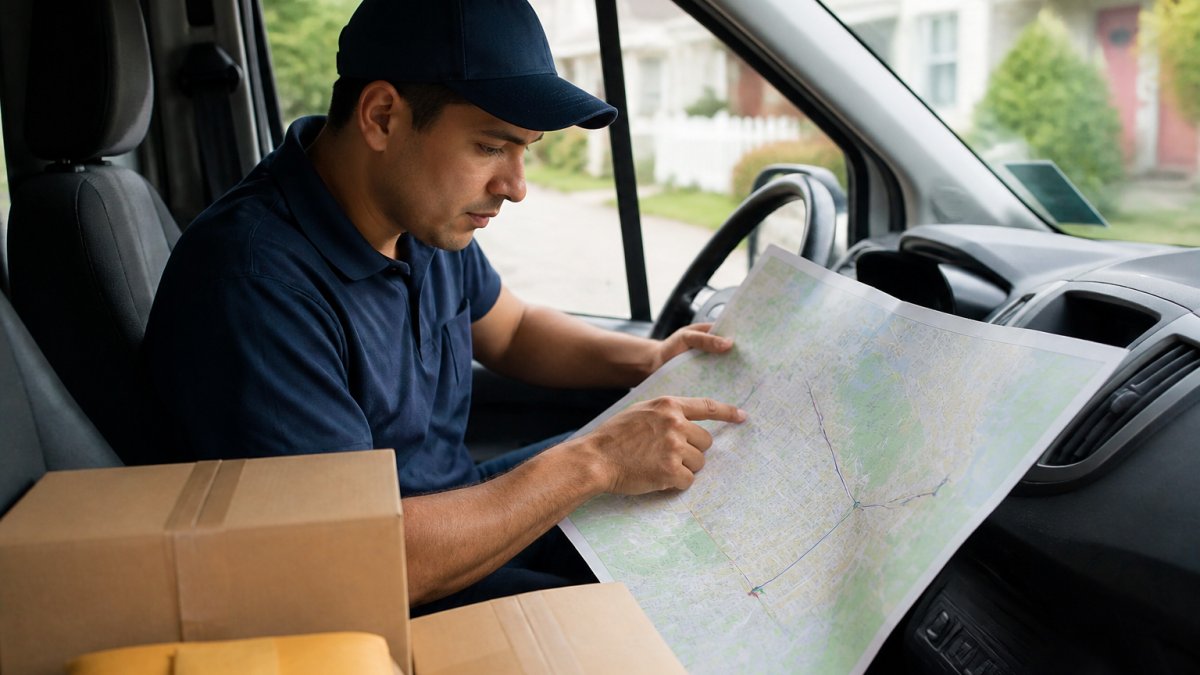
Map your routes before the day starts. Avoid assigning stops in random order and expecting drivers to optimize on the fly.
How to Reduce Missed Deliveries
A missed delivery happens when the driver arrives but cannot complete the handoff. In residential delivery, the causes are usually predictable: the customer wasn't home, the gate was locked, the apartment buzzer didn't work, parking wasn't available, a pet was loose in the yard, or the package was too large or too valuable to leave safely. Preventing these failures is far cheaper than recovering from them, because a second trip doubles fuel and labor on that stop and often triggers a refund, reship, or negative review.
Fix the address and access data first
Most missed deliveries trace back to bad data, not bad drivers. Before a stop is assigned, confirm:
- Unit and access details, apartment number, gate code, buzzer instructions, or a note that the building requires a call on arrival.
- Parking reality, whether the driver can legally stop near the door, or whether a longer walk, a loading zone, or a paid lot is required.
- Stairs, elevators, and long carries, heavy or bulky items to a walk-up take real time and should be flagged so the route isn't overbooked.
- Pets and yard hazards, a note that a dog is in the yard or that the gate must stay closed protects both the driver and the package.
- Safe drop-off location, front door, side porch, parcel locker, or a neighbor who has agreed to accept the package.
Flag known problem addresses (gated communities, buildings without working buzzers, businesses that close early) so dispatchers can pad the time or route them earlier in the day.
Confirm availability before the window
A short confirmation step removes most first-attempt failures:
- Send a notification the day before the scheduled window.
- Include a way for the customer to reply with special instructions (side gate, back door, leave with neighbor, do not leave unattended).
- Ask the customer to confirm they'll be home during the window, especially for high-value or signature-required items.
- On the delivery day, send a reminder shortly before arrival so the customer isn't caught off guard.
Build a recovery plan before you need one
When a delivery does fail, the speed and clarity of the recovery determines whether the customer stays. A practical sequence:
- Log the exact failure reason, no answer, locked gate, no safe place, refused, wrong address, so patterns become visible.
- Attempt a second delivery at a different time of day, ideally within one to two business days.
- Offer an alternative handoff, a secure locker, a staffed pickup point, or a neighbor who has agreed to accept it.
- Let the customer reschedule to a window that actually fits their availability.
- Notify the customer immediately with the new plan, not after the fact.
Measure first-attempt success, not just on-time rate
The single most useful residential metric is first-attempt delivery success rate, the share of stops completed on the first try without a return trip. Most well-run residential operations target the mid-90s and treat anything below roughly 90% as a signal that windows are too tight, access data is stale, or confirmation steps are being skipped. Pair it with cost per stop and cost per failed attempt so the operational cost of misses is visible to the whole team, not just the driver.
Managing the Delivery Rescheduling Process
Customers reschedule deliveries for many reasons: they won't be home, they want a different time, or the original window doesn't work.
Make rescheduling easy. Offer it through multiple channels: email link, SMS, website portal, or phone call.
When a customer reschedules, update your route immediately. Don't wait until the morning of the new delivery date.
Set clear rescheduling deadlines. Allow changes up to 24 hours before the scheduled window. After that, changes become logistically difficult.
Track rescheduling patterns. If many customers reschedule from certain time slots, those windows don't match customer availability. Adjust your offered windows based on what customers actually choose.
Choosing Delivery Scheduling Software
Delivery scheduling software automates route planning, customer communication, and tracking. The right tool saves time and reduces errors.
Look for these core features:
- Automated route optimization, The software groups stops and sequences them efficiently, not you
- Customer self-service, Customers can select delivery windows and reschedule without calling you
- Real-time tracking, Drivers can update status, and customers see live location
- Integration with your order system, Deliveries pull automatically from your e-commerce platform
- Driver app, Drivers see their route, navigate between stops, and confirm deliveries from their phone
- Performance reporting, Track on-time rates, first-attempt success, and cost per delivery
Not all software is right for every business. A small team might need a simple scheduling tool. A large operation needs full route optimization and driver management. Start with what you actually need, not the most feature-rich option.
Test the software with a small pilot before rolling it out company-wide. Let your drivers use it for a week. Ask for feedback. Make sure it fits your workflow before committing.
Communicating Schedules and Changes to Customers
Clear communication is what turns a scheduled window into a kept promise. In residential delivery, the customer is also the recipient, the gatekeeper, and often the person who has to be physically present, so the message has to do more than announce a time. It has to set expectations, offer control, and absorb the inevitable disruptions.
What every delivery notification should contain
Send a notification at least a day before the scheduled window, and include:
- The delivery date and the specific time window.
- The driver's name and a contact number, so the customer can flag a last-minute problem.
- A live tracking link so the customer can see progress without calling.
- A clear place to add special instructions, side gate, back door, leave with neighbor, do not leave unattended.
- A one-tap way to reschedule if the window no longer works.
On the day of delivery, send a short reminder shortly before arrival. This single step prevents a large share of no-answer failures, because the customer is prompted to be ready rather than relying on memory.
Offer real window choice, and be honest about the trade-off
Customers want narrow windows; operations want wide ones. The honest move is to let the customer choose and explain what each choice costs them:
- Narrow windows (often two hours) give certainty but may carry a premium or be limited to high-density areas.
- Wider windows (often four hours) are easier to hit and usually cheaper, but require the customer to be flexible.
When customers understand that a tighter window means a more expensive or less flexible route, most will self-select the option that fits them, which reduces both complaints and missed handoffs. Letting customers pick their own window through a self-service portal also cuts call volume and gives you cleaner data on which windows customers actually want.
Handle delays and disruptions proactively
Traffic, weather, and vehicle problems will break schedules. The difference between a frustrated customer and a patient one is almost always how early they were told.
- Notify before the window, not after. As soon as a delay is known, send a new estimated arrival time.
- Build buffer time into routes so small delays don't cascade into missed windows.
- Reroute and reprioritize when conditions change, move time-sensitive or perishable stops earlier and push flexible ones later.
- Give the customer a choice when a delay is unavoidable: wait for the new time, reschedule, or switch to a pickup point.
Close the loop after delivery
When the delivery is complete, send a confirmation. If your process allows, include a photo of the package at the drop location. This protects you if the customer later claims the item wasn't received, and it gives the customer confidence that the handoff happened as planned. A short follow-up asking whether the delivery met expectations also feeds directly into the satisfaction metric you should be tracking alongside first-attempt success.
Frequently Asked Questions
What are the key benefits of scheduling home deliveries in advance?
Advance scheduling reduces failed delivery attempts, improves customer satisfaction, and allows better route planning. When customers commit to a delivery window, drivers can optimize their sequence and reduce travel time. This leads to faster service, lower operational costs, and fewer rescheduling requests. Customers also appreciate knowing exactly when to expect their delivery, which fits better into their schedules.
How can delivery scheduling software reduce missed deliveries?
Delivery scheduling software automates customer notifications, tracks real-time driver locations, and enables customers to adjust their availability before delivery. The system can send reminders 24 hours and 2 hours before arrival, request customer confirmation of access instructions, and flag high-risk deliveries (gated homes, apartment buildings). Automated workflows reduce human error and ensure no customer is forgotten.
What should be included in a delivery rescheduling process?
A solid delivery rescheduling process includes: immediate customer notification of delays, multiple available time slots to choose from, confirmation of the new appointment, and clear communication about any charges. Customers should be able to reschedule online or by phone, and the system should log all changes for driver reference. Always confirm special access instructions (gate codes, apartment numbers, delivery preferences) during rescheduling.
How far in advance should customers schedule home deliveries?
Scheduling in advance allows time for route planning and driver assignment. Offering customers a choice between standard and expedited options can balance convenience with operational efficiency.


