


Table of Contents
- Why Busy Homes Need a Lean Kitchen Cleaning Kit
-
Essential Kitchen Cleaning Supplies: The 7 Picks
- Starter essentials vs. optional upgrades
- 1. High-Pressure Cleaner ($95.99)
- 2. Swivel Faucet Spout Extender with Anti-Splash Filter ($12.99)
- 3. Multi-Functional Kitchen Drain Basket ($15.99)
- 4. Toilet Disposable Brush ($46.99)
- 5. Microfiber Cloths and Reusable Wipes
- 6. Sponges, Scrubbers, and a Scrub Brush
- 7. All-Purpose Cleaner, Glass Cleaner, and Dish Soap
- Kitchen Cleaning Tools That Save the Most Time
- How to Clean a Kitchen Quickly on a Weeknight
- An Everyday Kitchen Cleaning Routine That Sticks
- Small-Space Storage for Kitchen Cleaning Supplies
- Reusable vs. Disposable: Ongoing Cost and Safety
- Conclusion
- Frequently Asked Questions
Last Updated: October 18, 2026
Why Busy Homes Need a Lean Kitchen Cleaning Kit
Most kitchen cleaning supplies sit unused because they were bought for a problem you do not actually have. A busy household does not need twenty bottles. It needs a short list of tools that handle grease, food spills, and daily wipe-downs without turning cleanup into a project.
This guide is built around a simple idea: the best kitchen cleaning tools are the ones you will actually reach for on a Tuesday night.
Essential Kitchen Cleaning Supplies: The 7 Picks
A practical kitchen kit covers four jobs: degreasing, rinsing, draining, and sanitizing. The picks below map to those jobs, and each one earns its counter space.
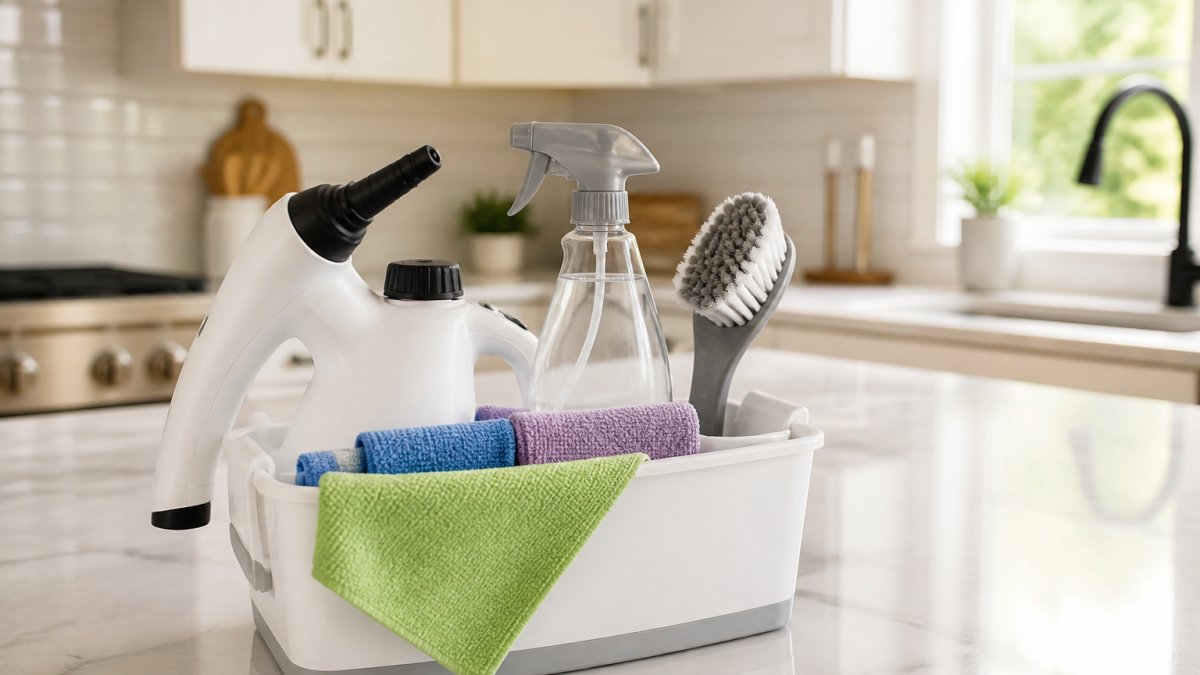
Starter essentials vs. optional upgrades
- Starter essentials (buy first): microfiber cloths, a non-scratch sponge, a scrub brush, dish soap, an all-purpose cleaner, and a glass cleaner. These cover daily wipe-downs, dishes, and most countertop messes.
- Optional upgrades (add if needed): a high-pressure steam cleaner for heavy grease, a swivel faucet extender for small sinks, a drain basket for prep-heavy cooking, and a disposable toilet brush for whole-home cleaning passes.
This split keeps first-time buyers from overbuying and gives busy households a clear path to expand only when a specific problem appears.
1. High-Pressure Cleaner ($95.99)
The High-Pressure Cleaner is the one tool here that replaces several bottles at once.

Best for: stovetops, range hoods, exhaust fans, sink rims, faucet bases, appliance fronts, and window tracks. Skip it if: your kitchen is small and your messes are light, a spray bottle and cloth handle most days.
The honest trade-off: it is the biggest spend in the kit, and it is a tool you plug in rather than grab.
2. Swivel Faucet Spout Extender with Anti-Splash Filter ($12.99)
The Swivel Faucet Spout Extender is the cheapest fix in the kit and the one guests notice. A 360-degree swivel head directs water where you need it, and the anti-splash filter cuts the spray that lands on countertops and shirts. It attaches to most standard kitchen faucets without special tools.
Best for: rinsing dishes, filling pots, and cleaning the sink itself. Less splashing means less wiping, which is the whole point. Skip it if: your faucet already has a pull-down sprayer with good reach.
3. Multi-Functional Kitchen Drain Basket ($15.99)
The Multi-Functional Kitchen Drain Basket handles washing, draining, and prep in one step. Evenly spaced drainage holes move water fast, and the ABS plastic body is lightweight enough to move from sink to counter and back. It comes in transparent and gray.

This is not a cleaning product in the strict sense. It is a mess-prevention product, and that counts. Best for: produce rinsing, pasta draining, and air-drying utensils. Skip it if: you already use a colander and drying rack daily.
4. Toilet Disposable Brush ($46.99)
The Toilet Disposable Brush belongs in the wider household kit rather than the kitchen itself, but it solves the same problem: cleaning without spreading grime. Water-activated heads release cleansing agents on contact, a one-touch release swaps heads without touching them, and the heads are safe for glazed surfaces.

Best for: whole-home cleaning passes and households that want to avoid storing a wet brush. Skip it if: you clean the bathroom separately and already have a system you like.
5. Microfiber Cloths and Reusable Wipes
Two cloths do most of the daily work: one for damp wiping, one for drying glass and countertops. Color-code them so the sink cloth never touches the stovetop. Microfiber lifts grease and dust without cleaner on light messes, which saves both product and time. Best for: counters, appliance fronts, glass, and sink rims. Skip it if: you prefer paper towels and accept the ongoing cost.
6. Sponges, Scrubbers, and a Scrub Brush
Keep one non-scratch sponge for everyday dishes and one scrub brush for stovetop grates and sink edges. Replace sponges often; they are the dirtiest item in most kitchens. A stiff brush reaches grates and corners a sponge cannot, and it rinses cleaner between uses. Best for: dishes, grates, sink edges, and baked-on spots. Skip it if: you already have a brush you reach for daily.
7. All-Purpose Cleaner, Glass Cleaner, and Dish Soap
A multipurpose all-purpose cleaner, a glass cleaner for windows and appliance fronts, and dish soap cover the rest. Add vinegar and baking soda for stains and odors, and a degreaser only if you cook with a lot of fat. Best for: counters, glass, dishes, and light degreasing. Skip it if: you already have a cleaner you trust for these surfaces.
Kitchen Cleaning Tools That Save the Most Time
The kitchen cleaning tools that save the most time are the ones that remove a step, not the ones with the most features. A steam cleaner that skips the spray-and-scrub cycle beats a cabinet full of specialty bottles. A faucet extender that reaches the whole sink beats a sponge on a stick.
Ranked by time saved per week, here is how we would prioritize:
| Tool | Job It Replaces | Best Surfaces and Messes | Time Saved | Priority |
|---|---|---|---|---|
| High-pressure steam cleaner | Degreaser plus scrubbing | Stovetop, range hood, exhaust fan, sink rims, faucet bases, appliance fronts, window tracks | Cuts stovetop and hood work to one pass | Buy first if grease is your problem |
| Swivel faucet extender | Extra wiping after splashes | Sink basin, dishes, pots, countertops near the sink | Less counter cleanup every wash | Buy first if space is tight |
| Drain basket | Colander plus drying rack | Produce, pasta, utensils, sink area | One step instead of two during prep | Everyday upgrade |
| Microfiber cloths | Paper towels | Counters, glass, appliance fronts, sink rims | Fewer trips to the store | Everyday upgrade |
| Scrub brush | Sponge on grates | Stovetop grates, sink edges, baked-on spots | Faster stovetop cleaning | Cheap add-on |
Surface-by-surface quick reference
- Counters: microfiber cloth plus all-purpose cleaner; dry glass with a second cloth.
- Stovetop and grates: scrub brush for daily spots; steam cleaner for baked-on grease.
- Sink and faucet: swivel extender to rinse the basin; microfiber cloth for the rim; scrub brush for edges.
- Appliances (exterior): glass cleaner for stainless and glass fronts; microfiber for fingerprints.
- Floor: sweep or vacuum first, then spot-mop; keep the mop out of the daily caddy.
Small-space and low-storage picks
If counter and cabinet space is tight, prioritize the swivel faucet extender, microfiber cloths, and a single caddy. Store the steam cleaner on the floor or in a closet, not on the counter. Hang the scrub brush and cloths on hooks inside the cabinet door. Move monthly-only products to a high shelf or utility closet so the daily caddy stays light.
Reusable vs. disposable cost per use
Reusable supplies cost more upfront and less over time. Microfiber cloths and reusable wipes replace paper towels week after week, and a good scrub brush outlasts dozens of sponges. Disposables win on hygiene in one place: toilet brush heads, where a fresh head per clean avoids storing a wet brush. For busy households, the practical rule is to keep reusables for daily surfaces and reserve disposables for the jobs where hygiene matters most.
How to Clean a Kitchen Quickly on a Weeknight
Cleaning a kitchen quickly on a weeknight comes down to order, not effort. Work top to bottom, dry to wet, and finish with the floor. Twenty focused minutes beats an hour of wandering.
- Clear counters and load the dishwasher first.
- Spray the stovetop and sink, then let the product sit while you wipe counters.
- Wipe counters and appliance fronts with a damp microfiber cloth, then dry glass with a second cloth.
- Scrub the stovetop and sink, then rinse.
- Sweep or vacuum the floor, then spot-mop.
- Take out the trash and replace the liner.
An Everyday Kitchen Cleaning Routine That Sticks
An everyday kitchen cleaning routine works when it is short enough to repeat. Ours is three tiers, and the daily tier takes under ten minutes.
- Daily: wipe counters, rinse the sink, load the dishwasher, sweep crumbs.
- Weekly: scrub the stovetop, clean the microwave, mop the floor, wash cloths.
- Monthly: degrease the range hood, clean the oven, wipe cabinet fronts, descale the faucet.
Small-Space Storage for Kitchen Cleaning Supplies
Small kitchens fail on storage before they fail on cleaning. The fix is a single cleaning caddy under the sink, holding only what you use weekly, with refills stored elsewhere.
- Keep one caddy, not three scattered baskets.
- Hang the scrub brush and cloths on hooks inside the cabinet door.
- Store the steam cleaner on the floor or in a closet, not on the counter.
- Move monthly-only products to a high shelf or utility closet.
Reusable vs. Disposable: Ongoing Cost and Safety
Reusable supplies cost more upfront and less over time. Microfiber cloths and reusable wipes replace paper towels week after week, and a good scrub brush outlasts dozens of sponges.
Safety matters more than the cost math. Keep cleaning products out of reach of children and pets, never store them in unmarked bottles, and ventilate the room when you use a strong degreaser. A chemical-free steam cleaner removes one category of risk from the kitchen entirely.
Conclusion
The hard part of kitchen cleaning is not the scrubbing. It is building a kit small enough that you actually use it.
MixVanta stocks the household supplies that make that kit easy to assemble in one order, with free shipping over $70, fast handling, and a 30-day money-back guarantee. Shop Now and build a kitchen cleaning kit that fits your week.
Frequently Asked Questions
What are the essential kitchen cleaning supplies every busy home should have?
A workable core kit covers four jobs: degreasing, wiping, scrubbing, and drying. That means a steam cleaner or all-purpose cleaner, microfiber cloths, a scrub brush or sponge, and paper towels or reusable cloths. Add a swivel faucet extender for sink rinsing and a drain basket for prep. Keep it all in one caddy so you carry it in and out in a single trip instead of hunting through cabinets mid-clean.
What kitchen cleaning tools actually make cleaning faster?
Tools that remove a step save the most time. A high-pressure steam cleaner loosens stovetop and range hood grease without pre-soaking or heavy scrubbing, and it reaches cracks a cloth misses. A 360-degree swivel faucet extender lets you rinse the sink and fill pots without splashing the counter, which means less wiping afterward. A drain basket keeps prep mess contained in one place. Fewer steps per task adds up over a week.
How often should you clean kitchen counters and appliances?
Wipe countertops daily, ideally right after the last meal, since food spills and crumbs attract pests and set into stains. Clean the stovetop and sink daily with a quick wipe and weekly with a deeper scrub. Appliances like the microwave and range hood benefit from a weekly once-over, with a deeper clean monthly. Busy homes do better with short daily passes than one long weekend session, because grime never gets a chance to harden.
How do busy people keep a kitchen clean without spending hours?
Clean as you cook and reset the room before bed. Ten minutes of wiping counters, rinsing the sink, and putting away dishes each night prevents the buildup that turns into a two-hour deep clean. Keep supplies in one caddy under the sink so there is no setup time. Use tools that do more per pass, like a steam cleaner for grease and a swivel faucet extender for rinsing, so each task takes one motion instead of three.
What should be in a basic kitchen cleaning kit for a small apartment?
For a small kitchen, keep it to items that store flat or hang: one all-purpose or steam cleaner, two or three microfiber cloths, a scrub brush, a small bottle of dish soap, and a drain basket. Skip bulky single-purpose gadgets. A swivel faucet extender takes up no cabinet space and improves sink cleaning, and a compact steam cleaner replaces several spray bottles. Store everything in a slim caddy that fits under the sink or on a door hook.


