


Last Updated: October 27, 2026
Quick Summary
Choose a pet nail grinder by matching motor power to nail thickness, keeping fresh grinding bands, and checking for low noise and vibration under load. A grinder with variable speed and a smooth, quiet motor gives you more control and reduces heat buildup that causes splitting.
- Replace the grinding band when grinding slows, the surface looks glazed, or you press harder.
- A dull band creates friction instead of cutting, and friction heats the nail.
- Run the grinder at top speed in your hand and feel for buzz before buying.
- Grinding one nail for more than a few seconds at a time is the most common cause of a yelping pet.
- Advance desensitization steps only when the pet stays relaxed on two separate sessions.
Table of Contents
- Start With Nail Thickness and Size, Not the Tool
- Dog Nail Grinder Features That Actually Matter
- Why a Quiet Nail Grinder for Dogs Changes the Whole Experience
- Dog Nail Grinder vs Clippers: Which Fits Your Pet
- Pet Nail Grinder Safety: Finding the Quick and Avoiding Heat Buildup
- Grip, Visibility, and Handling for You and Your Pet
- A Desensitization Plan for Nervous Pets
- Pick Your Grinder and Start With One Nail
- Frequently Asked Questions
Start With Nail Thickness and Size, Not the Tool
Nail thickness, nail length, and your pet's size are factors to consider when choosing a pet nail grinder.
If you are still assembling a grooming kit, our trending pet accessories for small dogs covers the pieces that pair well with a grinder.
Dog Nail Grinder Features That Actually Matter
A dog nail grinder is a rotary tool that sands down a nail with an abrasive band instead of cutting it. The features that matter are the ones that affect control, noise, and heat, not the ones printed largest on the box. Here is what to actually compare, in the order that changes the outcome.
Variable Speed and Motor Power
Motor power only matters in relation to nail thickness. A modest motor with a fresh band outperforms a strong motor with a worn one. The tell is stall behavior: if the head slows noticeably the moment you touch a thick nail, the motor is undersized for that pet. If it holds speed without bogging, it is matched correctly.
Grinding Bands, Grit, and Replacement Intervals
Bands wear out. A dull band creates friction instead of cutting, and friction is what heats the nail. Replace the band when grinding slows down, when the surface looks glazed or shiny, or when you notice yourself pressing harder to get the same result. Keep a spare on hand so you never push a tired band through one more session.
Noise, Vibration, and Heat Under Load
These three are linked and rarely listed together on a spec sheet. A motor that rattles under load transfers that vibration into the paw, and a band that has gone dull converts motor energy into heat instead of removal. When you evaluate a grinder, run it in your hand at the top speed and feel for buzz, then press the head lightly against a scrap of wood or a treat-free test surface and listen for the pitch changing from a hum to a grind. A tool that stays smooth under light load will stay calmer on a nail.
Battery, Charging, and Cordless Handling
Our Rechargeable Electric Pet Nail Grinder is a practical example of these features in one unit: a low-noise motor, USB rechargeable cordless operation, and a compact body for dogs and cats of various sizes.

Why a Quiet Nail Grinder for Dogs Changes the Whole Experience
Look for a low-noise motor and a body that does not rattle under load. If a grinder sounds harsh in your hand, it will sound worse to a pet with more sensitive hearing.
Dog Nail Grinder vs Clippers: Which Fits Your Pet
| Factor | Nail Clippers | Nail Grinder |
|---|---|---|
| Best for | Thin, light-colored nails | Thick, dark, or curved nails |
| Control | Single cut, less forgiving | Gradual, easier to stop |
| Edge finish | Can leave sharp corners | Smooths as it goes |
| Noise | Quiet | Depends on motor |
| Skill needed | Higher for dark nails | Higher for nervous pets |
| Splitting risk | Higher on thick nails | Lower with a fresh band |
Pet Nail Grinder Safety: Finding the Quick and Avoiding Heat Buildup
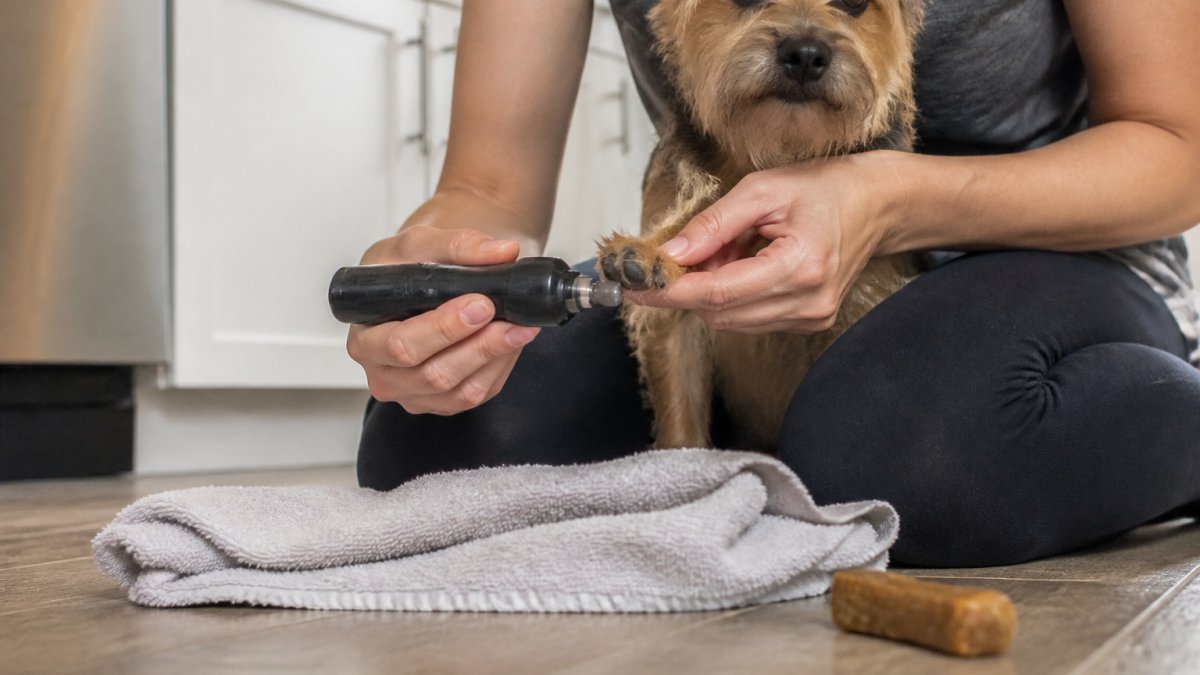
Watch out: grinding one nail for more than a few seconds at a time is the most common cause of a yelping pet, and it is entirely avoidable with short passes.
Rechargeable Electric Pet Nail Grinder →
Grip, Visibility, and Handling for You and Your Pet
A pet grooming comb is a useful companion here: comb the hair back from the paw before you start so nothing snags and you can see the whole nail.
A Desensitization Plan for Nervous Pets
Desensitization is a sequence, not a switch. You introduce the tool in steps and only move forward when the pet stays relaxed. Most guides stop at "go slow." The version below adds the part that actually matters: a milestone you have to hit before advancing, and a rule for backing up when you have moved too fast. This is the piece competitors skip, and it is the piece that decides whether the grinder gets used or sits in a drawer.
The Rule That Governs Every Step
Advance only when the pet shows relaxed body language at the current step on two separate sessions. Relaxed means loose posture, soft eyes, normal breathing, and willingness to take a treat. If you see a tucked tail, lip licking, yawning, freezing, or a pet that stops taking treats, you are past the threshold, back up one step and stay there for a few sessions. A pet that will not eat is a pet that is over threshold, not a stubborn one.
The Milestone Ladder
- Tool on the floor, off. Leave the grinder where the pet can see and sniff it. Milestone: the pet ignores it or investigates calmly. Treat for calm, not for sniffing.
- Tool in hand, off. Pick it up, set it down, pick it up again. Milestone: no avoidance when your hand moves toward it.
- Tool on, across the room. Run it for a few seconds, then turn it off. Milestone: the pet stays in the room and keeps taking treats while it runs.
- Tool on, at arm's length. Run it near the pet while you handle a paw for a few seconds. Milestone: paw handling stays relaxed with the sound present.
- Tool touching one nail, off. Touch the head to a nail with the motor off. Milestone: no paw withdrawal.
- Tool touching one nail, on, no grinding. One brief touch with the motor running, then stop. Milestone: the pet holds the paw still for the touch.
- One short pass on one nail. A single light pass, then stop for the day. Milestone: the pet accepts one pass without pulling away.
- Two nails, then three. Add one nail per session only while the previous session stayed calm.
Species and Temperament Adjustments
For a dog that is sound-sensitive but touch-tolerant, you can compress steps 1 through 4 and spend the time on steps 5 through 7. For a dog that is touch-sensitive but ignores noise, do the reverse. The ladder is the same; the pace is not.
What to Do When a Session Goes Wrong
A grooming glove for pets helps during the handling steps, since it lets you touch paws and legs gently while the pet adjusts.
Pick Your Grinder and Start With One Nail
At MixVanta, we offer the Rechargeable Electric Pet Nail Grinder for $31.99. It is suitable for dogs and cats and has a low-noise motor, USB-rechargeable battery, and cordless design.
Get started with MixVanta.
Frequently Asked Questions
How do I choose a nail grinder for my dog?
The Rechargeable Electric Pet Nail Grinder is suitable for dogs and cats of various sizes and breeds. It has a low-noise motor, USB-rechargeable battery, and compact, lightweight design.
Is a nail grinder better than nail clippers for pets?
Grinders leave smooth edges and let you remove small amounts at a time, which lowers the risk of cutting into the quick. Clippers are faster and quieter but can split or crack thick nails if the blade is dull. For pets with dark nails, where the quick is hard to see, a grinder gives more control. Nervous pets may do better with whichever tool they were slowly introduced to first.
Are pet nail grinders safe for cats?
The Rechargeable Electric Pet Nail Grinder is listed as suitable for dogs and cats.
How often should I grind my pet's nails?
Most dogs need nail maintenance every two to four weeks, depending on how much they walk on hard surfaces. Cats benefit from a check every two to three weeks. Grinding small amounts often beats one long session, because it keeps nails short without stressing the quick. Replace worn grinding bands as soon as they stop removing material evenly, since a dull band means more passes and more heat.


