


Table of Contents
- The Real Cost of Free Shipping: What Actually Happens to Your Profit Margin
- How Free Shipping Affects Conversion Rates and Shopping Cart Abandonment
- Setting a Minimum Order Value for Free Shipping That Works
- Is Free Shipping Worth the Wait? Speed vs. Savings Trade-offs
- Calculating Whether Free Shipping Pays for Itself
- Free Shipping Strategies That Protect Your Bottom Line
- Conclusion: When Free Shipping Makes Business Sense
Last Updated: August 22, 2026
Is Free Shipping Always Worth It for Your Business?
Free shipping has become table stakes in e-commerce. Customers expect it. Competitors offer it. But the question every business owner wrestles with is whether the math actually works.
The answer isn't yes or no. It's conditional. At MixVanta, we've analyzed shipping strategies across orders, and what we've found is that free shipping can be a significant profit driver or a fast way to erode margins, depending on how it's structured.
This guide breaks down the real cost of free shipping, shows you how to calculate whether it makes sense for your business model, and reveals the strategies that let you offer it without sacrificing profitability.
The Real Cost of Free Shipping: What Actually Happens to Your Profit Margin
Free shipping isn't free. Someone pays for it. The question is whether that someone is you, your customer, or both.
When you absorb shipping costs directly, you're reducing your profit margin on every order. A $50 item with a $7 shipping cost now nets you $43 instead of $50. If your profit margin was 30%, that shipping cost just cut it to 24%. Scale that across hundreds or thousands of orders monthly, and you're looking at significant money leaving your business.
The common approach is to build the cost into your product pricing. A $50 item becomes $57, and you offer free shipping. Customers see "free shipping" and feel like they're getting a deal, even though they're paying the same total. This psychological perception matters, it affects conversion rates and customer satisfaction.
But here's where it gets complicated: if you raise prices to cover shipping, you risk losing price-sensitive customers who compare your $57 item against a competitor's $50 item with paid shipping. They see the higher price first and bounce. The psychological benefit of "free shipping" only works if customers don't perceive the cost elsewhere.
The real impact on your profit margin depends on three factors: your current shipping costs, your product category, and your customer acquisition cost. Logistics costs vary wildly. A lightweight household item costs $2-4 to ship domestically. Electronics can run $8-15. Bulky items might hit $15-25. If your profit margin is thin to begin with, absorbing shipping costs is unsustainable.
How Free Shipping Affects Conversion Rates and Shopping Cart Abandonment
Free shipping is one of the most effective levers for reducing shopping cart abandonment. Customers abandon carts for three main reasons: unexpected costs at checkout, slow shipping, or price concerns. Free shipping addresses two of those directly.
When a customer reaches checkout and sees "Free Shipping" instead of a $7-12 charge, the perceived total price drops. That moment matters. Studies on consumer behavior consistently show that transparent pricing and perceived value significantly influence the decision to complete a purchase (peer-reviewed research).
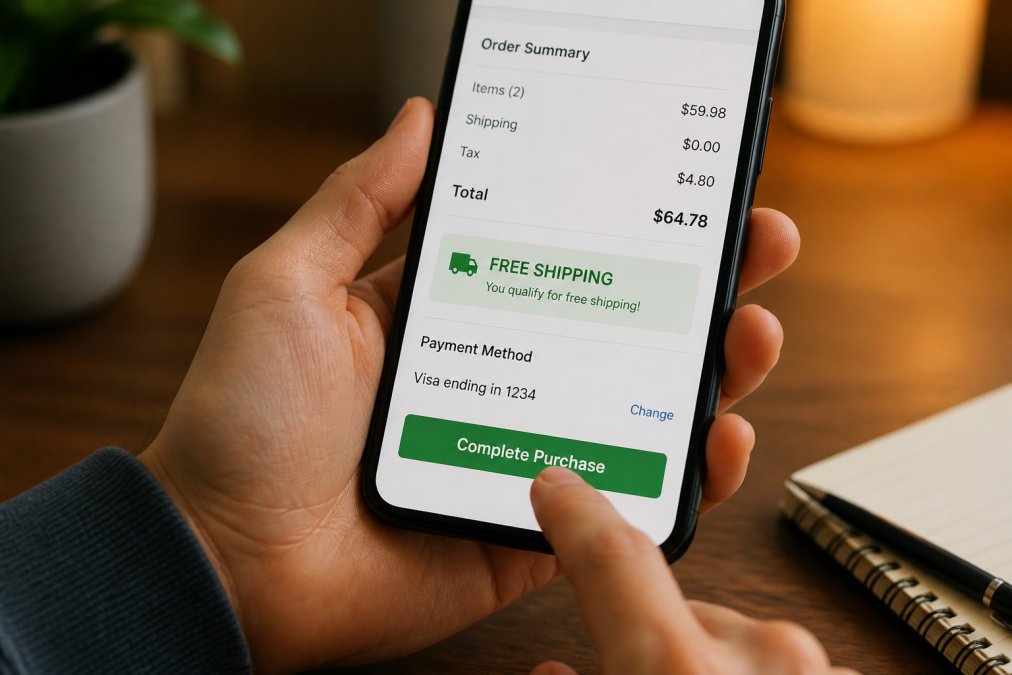
But free shipping only works if customers know about it before they hit checkout. Surprise shipping charges at the last step drive abandonment. If you're offering free shipping, communicate it early: in product listings, in email campaigns, on your homepage. The earlier the customer sees it, the more it influences their decision to add items to their cart.
There's also a threshold effect. Customers are more likely to complete purchases when free shipping applies to their order. If you're using a minimum order value threshold for free shipping, make that threshold visible and easy to reach. Many customers will add items specifically to hit a free shipping threshold, that's checkout friction working in your favor, driving higher average order values.
Setting a Minimum Order Value for Free Shipping That Works
A minimum order value for free shipping is a strategic tool. It protects your margins while still offering the incentive. The question is: what threshold works?
The minimum order value should be high enough to cover your shipping costs and maintain your target profit margin, but low enough that a meaningful percentage of your customers hit it naturally. If you set it too high, customers see it as a barrier and abandon. If you set it too low, you're barely protecting margins.
Start by calculating your average order value. If your AOV is $45, setting a free shipping minimum at $75 means you're only capturing free shipping on higher-value orders, which is strategic, but you're leaving conversion upside on the table. If your AOV is $65, a $75 minimum is aggressive but reachable.
The sweet spot for most e-commerce businesses is a minimum that sits 10-20% above your current average order value. This encourages customers to add one or two more items to hit the threshold, increasing their total spend while you absorb shipping on a higher-value order where margins are less damaged.
Consider tiered free shipping thresholds. Offer free shipping at $50 for standard delivery (7-10 business days) and $100 for expedited delivery (2-3 business days). This creates a choice: customers can get free shipping by waiting, or pay for speed. You're not absorbing the cost of expedited shipping, and you're still capturing the psychological benefit of "free shipping" at a lower threshold.
Test your threshold. If you're currently using a $75 minimum, try $65 for two weeks and measure the impact on conversion rate, average order value, and total profit. The data will tell you whether the incremental conversions offset the additional shipping costs.
Is Free Shipping Worth the Wait? Speed vs. Savings Trade-offs
Customers face a trade-off: free shipping often means slower delivery. Standard shipping typically takes 7-10 business days (the FTC). Expedited options cost extra but arrive in 2-3 days.
This trade-off is where many e-commerce businesses get the calculation wrong. They assume free shipping = slower shipping = lower customer satisfaction. But the data shows something different: customers are willing to wait for free shipping. The psychological value of "free" outweighs the inconvenience of waiting, especially for non-urgent purchases.
However, there's a limit. If your free shipping takes 14+ days, you're testing customer patience. Anything over 10 business days feels slow in 2026 (the CDC). If your fulfillment partner can't deliver free shipping in under 10 days, the offer loses its appeal.
The speed question also depends on your product category. If you're selling household supplies or gadgets, customers can wait. If you're selling perishables, time-sensitive items, or products for immediate needs, slower shipping becomes a real problem. MixVanta's diverse catalog means some products benefit from fast free shipping, while others can support a longer timeline.
Consider offering both options: free shipping with standard delivery, and paid expedited shipping. This gives customers control. Price the expedited option at your actual cost plus 20-30% margin. Customers who need it fast will pay. Customers who can wait get the free option. Both benefit your bottom line.
Calculating Whether Free Shipping Pays for Itself
This is the calculation that actually matters. Does free shipping increase your profit, or does it just increase your costs?
Start with these numbers:
- Your current average order value
- Your current conversion rate
- Your average shipping cost per order
- Your profit margin per order (before shipping)
- Your customer acquisition cost

Free shipping impacts conversion rate and average order value. If free shipping increases your conversion rate from 2% to 2.5%, that's a 25% lift. If it increases average order value from $50 to $58 because customers add items to hit the free shipping threshold, that's an 16% lift. These numbers compound.
Here's a simplified model:
Current state (no free shipping):
- 1,000 monthly visitors
- 2% conversion rate = 20 orders
- $50 average order value = $1,000 revenue
- $7 average shipping cost per order = $140 total shipping
- 30% profit margin = $300 profit (before shipping costs)
- Profit after shipping = $160
With free shipping (absorbed cost):
- 1,000 monthly visitors
- 3% conversion rate = 30 orders (50% lift)
- $58 average order value = $1,740 revenue
- $7 average shipping cost per order = $210 total shipping (you absorb it)
- 30% profit margin = $522 profit (before shipping costs)
- Profit after shipping = $312
In this scenario, free shipping nearly doubled your profit despite the additional shipping costs you're absorbing. The conversion lift and higher average order value more than offset the shipping expense.
But this assumes you can achieve a 50% conversion lift. Real results vary. A 15-25% conversion lift is more typical. Run the math with your actual numbers. If a 20% conversion lift plus 10% higher average order value doesn't offset your shipping costs, free shipping might not be the right strategy for your business.
The calculation also depends on whether you're raising prices to cover shipping or absorbing the cost. If you raise prices, you need to model for potential price sensitivity and lost customers. If you absorb the cost, the math is simpler but the margin impact is direct.
Free Shipping Strategies That Protect Your Bottom Line
Free shipping doesn't have to be all-or-nothing. Strategic variations let you offer it without destroying profitability.
Threshold-based free shipping is the most common. Offer free shipping on orders over a set amount. This protects margins on small orders while capturing the conversion benefit on larger ones. The threshold should be reachable but not trivial, it should encourage incremental purchases.
Tiered free shipping offers different speeds at different price points. Free standard shipping at $50, free expedited at $100. This segments customers by urgency and willingness to pay. Customers who can wait get free shipping at a lower threshold. Customers who need speed pay for it. Both segments generate profit.
Category-based free shipping applies the offer only to high-margin products or lightweight items. If your electronics have 40% margins and your apparel has 25%, offer free shipping on electronics and charge for apparel. Customers see free shipping on the categories that matter most to them.
Seasonal free shipping lets you test the offer during high-traffic periods. Run free shipping promotions during peak shopping seasons when higher volume offsets the shipping costs. Pull back during slower periods. This reduces annual shipping expense while maintaining the conversion lift when it matters most.
Loyalty-based free shipping ties the offer to customer status. Free shipping for members or repeat customers, paid shipping for new customers. This incentivizes sign-ups and repeat purchases while protecting margins on one-time buyers who generate lower lifetime value.
Free shipping with a catch, the offer applies only to specific payment methods, specific shipping speeds, or orders placed during specific windows. These conditions reduce the number of orders qualifying for free shipping, protecting your costs while still offering the psychological benefit to customers who take the action you want.
The best strategy combines two or three of these. For example: threshold-based free shipping ($60 minimum) plus tiered speeds (free standard, paid expedited) plus seasonal adjustments (increase threshold during slow periods). This protects margins while maintaining customer perception of value.
Conclusion: When Free Shipping Makes Business Sense
Free shipping is worth it when the conversion lift and increased order value exceed your shipping costs. It's not worth it when you're absorbing costs without seeing meaningful changes in customer behavior.
The calculation is specific to your business. Your shipping costs, margins, customer acquisition cost, and price sensitivity all factor in. The only way to know is to model it with your actual numbers, test it, and measure the results.
At MixVanta, we offer free shipping on orders over $70 because this threshold drives higher average order values and conversion rates that more than offset the shipping cost. It works for our business model. Your threshold might be different.
If you're considering free shipping, start with a test. Run it for 4-6 weeks with a specific threshold and measure conversion rate, average order value, and total profit. Compare the results to your baseline. If profit increases, expand the offer. If it decreases, adjust the threshold or try a different strategy.
The goal isn't to offer free shipping because everyone else does. The goal is to offer it because the math works for your business and it drives real profit growth.
=== FAQ ANSWERS (audit these too, same rules) ===
[1] Q: Do companies actually lose money when they offer free shipping? A: Not necessarily. Companies can offer free shipping profitably by building shipping costs into product pricing, setting minimum order thresholds, or using negotiated rates with carriers. The key is understanding your unit economics, what you pay to fulfill an order versus what customers spend. Many successful retailers absorb shipping costs because the increased conversion rate and higher average order value more than offset the logistics expense. The real question is whether your specific business model supports it.
[2] Q: What's the best minimum order value for free shipping? A: The right minimum order value depends on your average order value, shipping costs, and profit margins. A common approach is to set it at 1.5 to 2 times your average shipping cost. For example, if your typical shipment costs $8 to $12, a $70 threshold encourages customers to add items while remaining achievable for most shoppers. Test different thresholds to see which increases order value without reducing conversion rates too much. Monitor your data, the best threshold is the one that maximizes total profit, not just order count.
[3] Q: Is free shipping worth the wait if delivery takes weeks? A: Speed matters more than you might think. Customers perceive free shipping as less valuable if it takes 3-4 weeks versus 5-7 days, even though they're paying nothing. Long delivery times increase the likelihood of cart abandonment and buyer's remorse. If you're offering free shipping with slow fulfillment, you're sacrificing the psychological benefit that makes free shipping effective. Consider offering tiered options: fast paid shipping for impatient customers, free standard shipping for those willing to wait. This way, you capture both segments and maintain profitability.
[4] Q: How do I know if free shipping is worth it for my business? A: Calculate your break-even point: multiply your average order value by your conversion rate, then subtract shipping costs and other fulfillment expenses. If the profit from increased orders exceeds the additional shipping overhead, free shipping works. Also measure shopping cart abandonment before and after offering free shipping, if it drops significantly, that's a strong sign. Track customer acquisition cost versus customer lifetime value; free shipping that drives repeat purchases pays for itself over time. The answer is different for every business, so test it with real data from your own operations.
Frequently Asked Questions
Do companies actually lose money when they offer free shipping?
Not necessarily. Companies can offer free shipping profitably by building shipping costs into product pricing, setting minimum order thresholds, or using negotiated rates with carriers. The key is understanding your unit economics, what you pay to fulfill an order versus what customers spend. Many successful retailers absorb shipping costs because the increased conversion rate and higher average order value more than offset the logistics expense. The real question is whether your specific business model supports it.
What's the best minimum order value for free shipping?
The right minimum order value depends on your average order value, shipping costs, and profit margins. A common approach is to set it at 1.5 to 2 times your average shipping cost. For example, if your typical shipment costs $8 to $12, a $70 threshold encourages customers to add items while remaining achievable for most shoppers. Test different thresholds to see which increases order value without reducing conversion rates too much. Monitor your data, the best threshold is the one that maximizes total profit, not just order count.
Is free shipping worth the wait if delivery takes weeks?
Speed matters more than you might think. Customers perceive free shipping as less valuable if it takes 3-4 weeks versus 5-7 days, even though they're paying nothing. Long delivery times increase the likelihood of cart abandonment and buyer's remorse. If you're offering free shipping with slow fulfillment, you're sacrificing the psychological benefit that makes free shipping effective. Consider offering tiered options: fast paid shipping for impatient customers, free standard shipping for those willing to wait. This way, you capture both segments and maintain profitability.
How do I know if free shipping is worth it for my business?
Calculate your break-even point: multiply your average order value by your conversion rate, then subtract shipping costs and other fulfillment expenses. If the profit from increased orders exceeds the additional shipping overhead, free shipping works. Also measure shopping cart abandonment before and after offering free shipping, if it drops significantly, that's a strong sign. Track customer acquisition cost versus customer lifetime value; free shipping that drives repeat purchases pays for itself over time. The answer is different for every business, so test it with real data from your own operations.
Ready to test free shipping on your platform? MixVanta's 30-day money-back guarantee and fast handling let you experiment with shipping strategies risk-free. See how free shipping impacts your customer behavior, then decide what works for your business model. [EXTERNAL_LINK: Explore MixVanta's shipping options | mixvanta.com]
This article was written using GrandRanker


