


Table of Contents
- What International Currency Fees Actually Cost You
- Best No Foreign Transaction Fee Credit Cards
- Dynamic Currency Conversion Explained
- Using Debit Cards Abroad: Fees, Risks, and Smarter Moves
- Always Pay in Local Currency: Why It Matters
- Digital Wallets, Multi-Currency Accounts, and Modern Alternatives
- Cash, Currency Kiosks, and Emergency Money Recovery
- Conclusion
Last Updated: August 13, 2026
What International Currency Fees Actually Cost You
International currency fees are charges applied by banks, card networks, and payment processors when a transaction is made in a currency different from your card's base currency. These fees typically include a foreign transaction fee from your card issuer, a currency markup from the card network, and sometimes additional processing fees. By the time the charge clears, you could be paying several percentage points above the actual exchange rate.
The MixVanta team put together this guide to help you understand exactly where these costs come from and how to stop paying them. Most travelers have no idea how many separate fees stack on a single transaction. The good news: most of these fees are entirely avoidable with the right payment method and a few simple habits.
According to Consumer Financial Protection Bureau guidance on credit card fees, cardholders have the right to review their cardholder agreement for all applicable fees before traveling.
| Fee Type | Who Charges It | Typical Trigger |
|---|---|---|
| Foreign transaction fee | Card issuer | Any overseas transaction |
| Currency markup | Card network | Conversion at non-interbank rate |
| ATM withdrawal fee | Your bank | International ATM use |
| ATM operator fee | Local bank | Using their machine |
| Dynamic currency conversion markup | Merchant/terminal | Paying in home currency abroad |
Best No Foreign Transaction Fee Credit Cards
The single most effective way to avoid international currency fees is to carry a credit card that charges no foreign transaction fee. Many travel-focused cards have eliminated this fee entirely.
What to Look for in a Travel-Friendly Card
When choosing a card for international use, prioritize these factors:
- No foreign transaction fee: Confirmed in the cardholder agreement
- Wide card network acceptance: Visa and Mastercard have broader global acceptance
- No currency markup beyond the interbank rate: Read the fine print for hidden margins
- ATM fee reimbursement: Some cards reimburse international ATM withdrawal fees
- Chip-and-PIN support: Many overseas merchants require PIN entry
A common mistake is assuming any travel rewards card automatically waives foreign transaction fees. Check the fee schedule in your cardholder agreement before you leave.
Subscription-Based Travel Cards Worth Considering
Subscription-based travel cards bundle fee waivers, travel insurance, and currency perks into a monthly or annual membership. Instead of earning points on spending, you pay a flat fee and get access to interbank-rate currency conversion and fee-free ATM withdrawals up to a monthly limit. For frequent travelers, the math often favors a subscription model over paying per-transaction fees. The trade-off is that these accounts may have spending limits on fee-free withdrawals, and the monthly cost adds up if you travel infrequently.
Dynamic Currency Conversion Explained
Dynamic currency conversion (DCC) is a payment service that allows a merchant or ATM operator to convert your transaction into your home currency at the point of sale. It sounds convenient. It almost always costs you more.
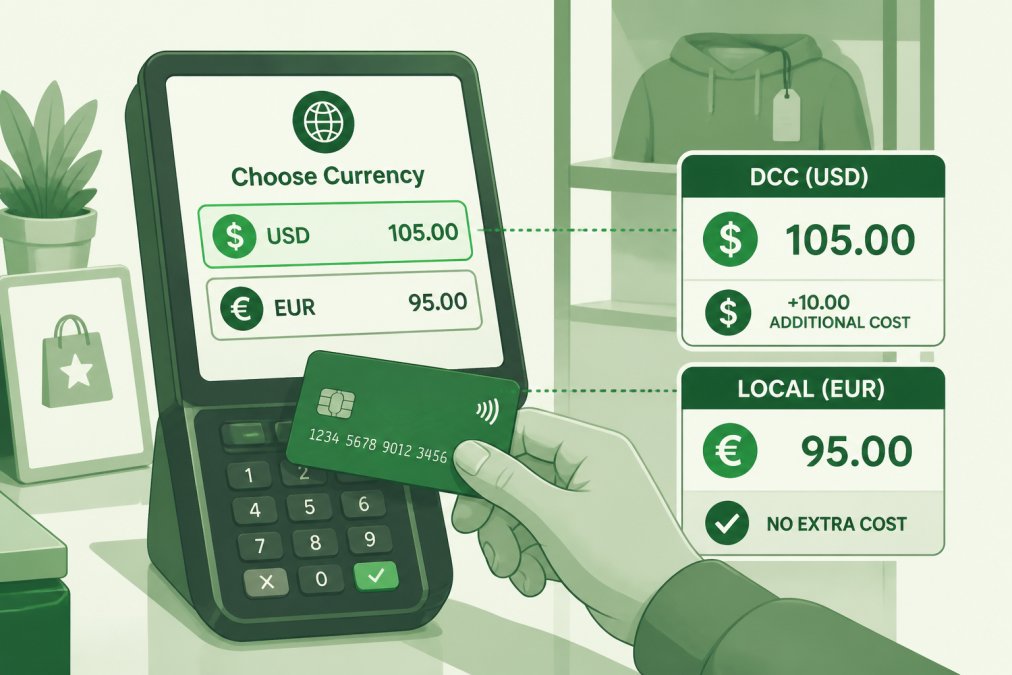
The exchange rate used by the merchant's terminal includes a markup, sometimes several percentage points above the interbank rate, and the merchant may receive a commission for steering you toward it. Your card issuer then applies its own foreign transaction fee on top. You end up paying twice.
According to Federal Reserve consumer payment research, cardholders often have limited visibility into the true cost of currency conversion at the point of sale.
How to Spot and Refuse DCC at the Point of Sale
The DCC prompt appears on the payment terminal screen after you tap or insert your card. It will ask whether you want to pay in your home currency or the local currency. Always choose local currency.
Watch for these scenarios: restaurant bills presented in your home currency, ATMs offering to "lock in" the exchange rate, retail terminals that default to your home currency, and online merchants showing prices in USD for international stores. If a merchant insists you must pay in your home currency, that is not accurate. You have the right to pay in local currency at any point of sale.
Using Debit Cards Abroad: Fees, Risks, and Smarter Moves
Using debit cards abroad introduces different problems compared to credit cards. When fraud occurs on a debit card, the money leaves your account immediately. For international travel, a debit card should be your secondary payment method. Use it for ATM withdrawals when you need local cash, but pay for purchases with a no-fee credit card wherever possible.
ATM Withdrawal Fees and How to Minimize Them
ATM withdrawal fees overseas typically stack in layers: your bank's international withdrawal fee, the ATM operator's surcharge, and potentially a currency conversion fee. Each layer is avoidable or reducible.
Practical steps to minimize ATM fees:
- Use your bank's global ATM network. Many major banks have partner networks overseas where withdrawal fees are reduced or waived.
- Withdraw larger amounts less frequently. Each withdrawal triggers a fixed fee.
- Decline DCC at the ATM. Always select the option to be charged in local currency.
- Use a debit card from an account with international fee reimbursement.
- Avoid airport and hotel ATMs. These typically charge higher operator fees.
Always Pay in Local Currency: Why It Matters
Paying in local currency is the single most consistent rule for avoiding unnecessary conversion fees. When you pay in local currency, your card network handles the conversion using its own exchange rate, which is typically close to the interbank rate. When you pay in your home currency through DCC, a third party handles the conversion at a worse rate and pockets the difference.
Over a two-week trip with dozens of transactions, this compounds into a meaningful portion of your travel budget. This rule also applies to online purchases from international merchants. Switch the currency toggle to local currency and let your card handle the conversion.
Digital Wallets, Multi-Currency Accounts, and Modern Alternatives
Digital wallets and multi-currency accounts have changed how to avoid international currency fees.
Digital wallets (Apple Pay, Google Pay): When linked to a no-fee travel credit card, digital wallets pass through the same fee structure as the underlying card. The benefit is contactless payment acceptance, which is near-universal in most developed markets.
Multi-currency accounts: These accounts hold balances in multiple currencies simultaneously. You fund the account in USD, convert to local currency at or near the interbank rate, and spend from that balance. Conversion happens before the transaction, so no foreign transaction fee applies at the point of sale.
Prepaid travel cards: Loaded in advance with a specific currency, these cards lock in an exchange rate at the time of loading. The advantage is predictability. Most prepaid travel cards also charge reload fees and inactivity fees, so read the full fee schedule.
MixVanta supports global currency display, which means international shoppers can see prices in their local currency before checkout rather than encountering surprise conversion charges after the fact.
| Payment Method | Foreign Transaction Fee | Best For |
|---|---|---|
| No-fee travel credit card | None | Most everyday purchases abroad |
| Multi-currency account | None (converted in advance) | Frequent travelers, expats |
| Subscription travel card | None (within monthly limit) | Regular travelers |
| Standard debit card | Varies (often 1-3%) | ATM withdrawals only |
| Prepaid travel card | None (at point of sale) | Fixed-budget trips |
| Standard credit card | Typically 1-3% | Avoid for overseas use |
Cash, Currency Kiosks, and Emergency Money Recovery
Cash still matters overseas, even as card acceptance expands. Some markets remain largely cash-based, and small vendors, transit systems, and rural areas may not accept cards. The question isn't whether to carry cash, but where to get it.

Currency exchange kiosks at airports and tourist areas are consistently the worst option for exchange rates. A bank-branded ATM in the destination city, using a fee-reimbursing debit card, almost always provides a better effective rate.
Where to exchange cash, ranked by cost:
- Bank ATMs in the destination city (best rate, lowest fees)
- Your home bank's foreign currency ordering service
- Credit unions with international exchange services
- Airport bank branches
- Currency exchange kiosks (avoid if possible)
Emergency money recovery: If your cards are lost or stolen overseas, you have several options: emergency card replacement (most major card issuers can deliver a replacement within 1-3 business days), emergency cash advance (Visa and Mastercard operate programs allowing cash at a local bank branch using a reference number), wire transfer (via Western Union or MoneyGram), or travel insurance cash advance. Store your card issuer's international phone number separately from your wallet.
Traveling with a plan for international currency fees is one of the highest-return preparations you can make before any trip. The fees are real, they stack up quickly, and they're almost entirely preventable with the right card, the right habits at the point of sale, and a basic understanding of how DCC works. MixVanta's global currency support means you can shop our catalog from anywhere without running into hidden conversion surprises at checkout. Shop Now and see prices displayed in your local currency before you commit to a purchase.
Frequently Asked Questions
Should I choose local currency or USD when paying abroad?
Always choose local currency. When a merchant or ATM offers to charge you in USD instead of the local currency, that is dynamic currency conversion (DCC). The merchant applies their own exchange rate, which is almost always worse than your card issuer's rate. Selecting local currency lets your bank handle the conversion, typically at or near the interbank rate. Paying in USD through DCC can add 3% to 7% on top of any foreign transaction fee your card already charges.
Do ATM withdrawals count as foreign transactions?
Yes. Overseas ATM withdrawals typically trigger two separate charges: a foreign transaction fee from your card issuer (often 1% to 3%) and a flat international withdrawal fee from your bank (commonly $3 to $5 per transaction). Some ATM operators also add their own surcharge. Using a checking account or travel card that reimburses ATM fees, and withdrawing larger amounts less frequently, reduces the per-dollar cost of each international currency fees hit.
Is it cheaper to use a credit card or debit card abroad?
A no-foreign-transaction-fee credit card is usually the better choice. Credit cards offer stronger fraud protection under federal law, no immediate cash drain from your account, and often better exchange rates than debit cards. Debit cards can trigger cash advance fees if used incorrectly, and lost funds take longer to recover. That said, a fee-free debit account with ATM reimbursements works well for cash withdrawals where cards are not accepted.
How do I avoid currency exchange fees when shopping online from international retailers?
Pay with a credit card that has no foreign transaction fee and make sure the checkout is set to charge in the retailer's local currency, not USD. Some online marketplaces, including those with global currency support, display final prices in your home currency and absorb conversion costs, so you see exactly what you pay before checkout. Avoid currency exchange kiosks for online purchases, they add unnecessary conversion layers and hidden costs.
This article was written using GrandRanker


